Divine Principle Bible
400 Years in Egypt as Indemnity
This illustration page is designed for the Exodus section and explains the 400 years in Egypt in relation to Divine Principle teaching on Abraham’s failure in the offering and the course of restoration through indemnity.
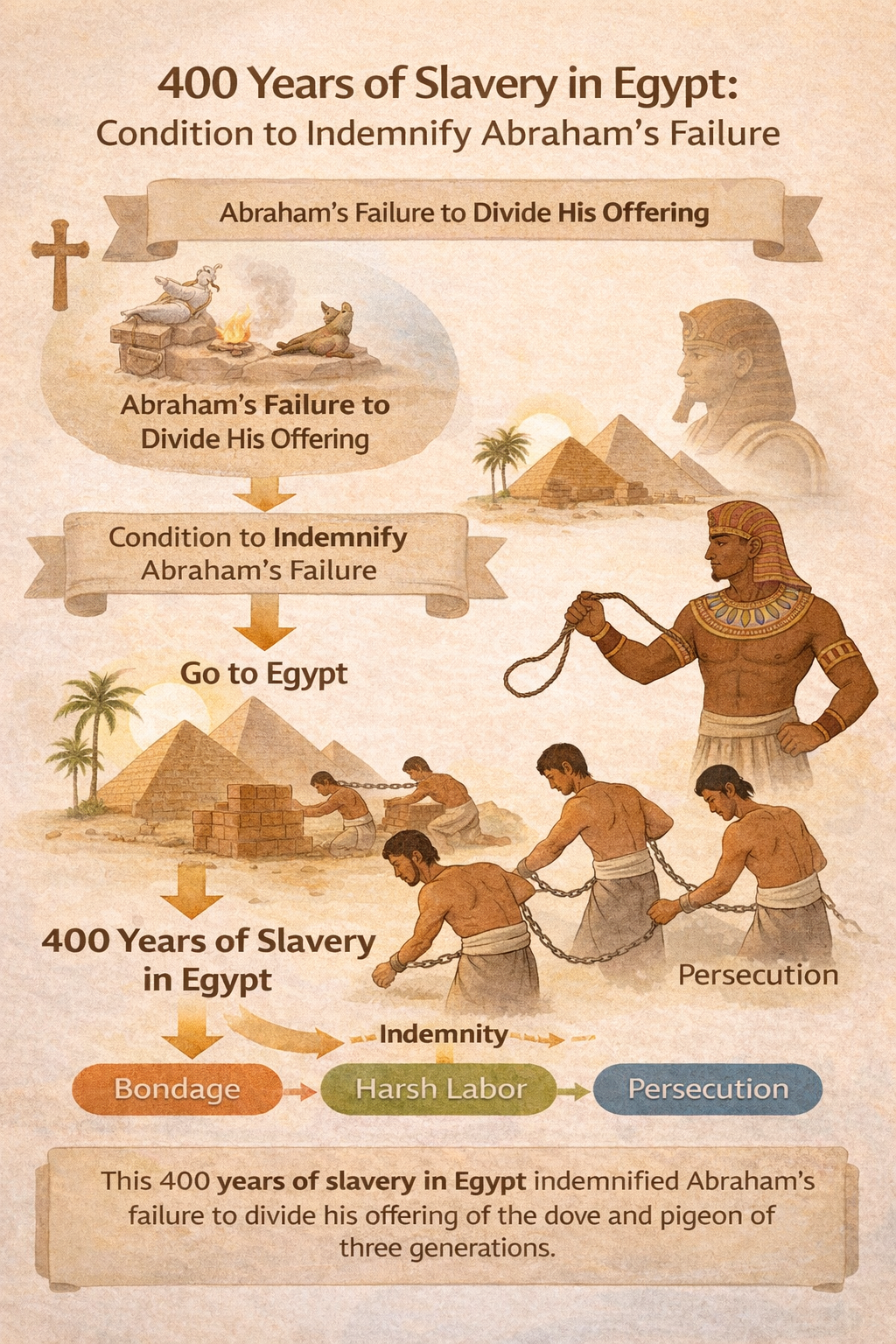
Illustration: 400 years in Egypt as a condition of indemnity connected to Abraham’s failure in the offering.
Father-centered indemnity note: Rev. Moon taught that salvation and restoration do not happen automatically. He taught that fallen humanity must pass back through the course of the fall by establishing indemnity conditions and then restoring what was lost. In this light, the 400 years in Egypt are understood as a historical course to indemnify Abraham’s failure in the offering and to prepare the people for a new providential beginning.
God of Divine Principle Commentary
I as God of Divine Principle say that the 400 years in Egypt were not meaningless suffering. In Divine Principle understanding, they were a prolonged providential condition to restore what had been lost when Abraham failed to complete the offering properly. The chosen line could not simply move forward as if nothing had happened. A historical condition had to be laid.
This is why the Exodus story must be read not only as political oppression, but also as providential indemnity. Bondage, harsh labor, and persecution became part of the national course through which the descendants of Jacob would stand in a new position before heaven. What one generation failed to establish symbolically had to be restored in history through the people.
For readers new to Divine Principle, this helps explain why restoration is often long, painful, and exact. Heaven does not abandon the promise, but neither does it erase the consequences of failure without a condition of restoration. The 400 years in Egypt therefore belong to the larger providence by which the foundation for the Messiah continues to expand from family level toward national level.